Building a Social Trading Platform from Zero — as Founder, Designer, and Everything Else
Client
Cryfi
Year
2023
Crypto trading has a trust problem. Pro traders have edge. Retail traders have noise. And the gap between them is filled with bad signals, unverifiable track records, and zero accountability.
Cryfi was built to close that gap. It's a social trading platform and signal marketplace where any trade or prediction — from a human expert or a trading bot — becomes a structured, on-chain verified Signal. Providers build transparent track records. Traders subscribe to the signals they trust. Everyone has skin in the game.
I founded Cryfi, designed the product, and took it from idea to live app to token launch.
Scope of Work
Impact
$22,000 raised through a private NFT sale, hackathons, and pitching competitions
23,000+ app activations and 11,000+ signals sent within the first year of launch
100,000+ followers across social channels, grown entirely through owned strategy
$1.2M peak market cap on token launch — on a $2,500 initial investment
Partnerships closed with KuCoin (top 10 global crypto exchange), Analog, UXLINK, Mizar, WOW EARN, Truth Network, Crypto Arsenal, and others
My Role
Founder & CEO — end-to-end.
Product vision, research, and feature definition
Full product design: UX, UI, IA, branding, marketing materials
Team management: 2 developers, BD lead, social media manager, marketing agency
Fundraising: NFT sale, hackathons, investor pitching
Growth strategy and execution: social, influencer, gamification
Business development: partnerships with KuCoin, Analog, UXLINK, and others
Token strategy and TGE execution
The Problem
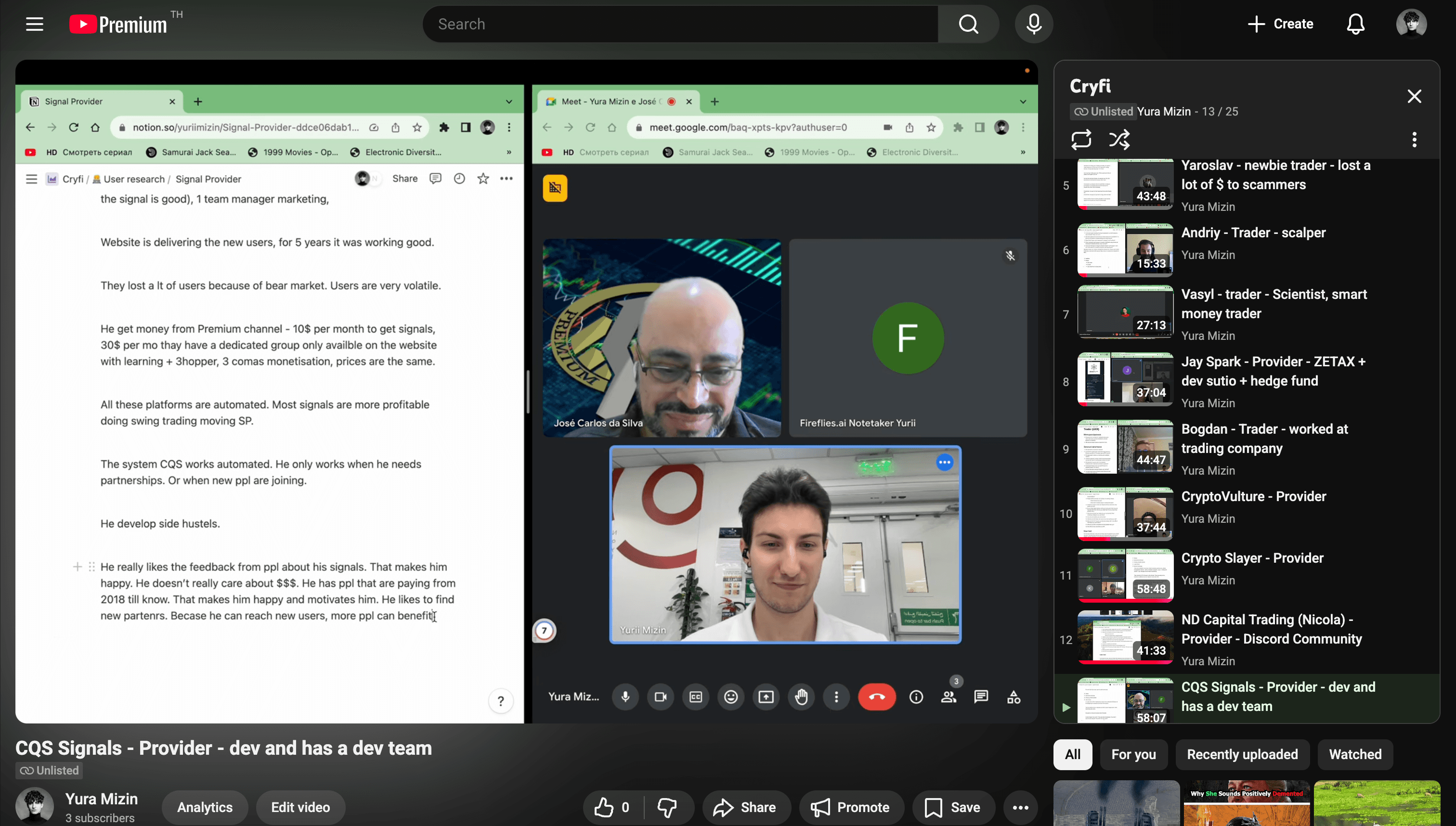
Before building anything, I needed to understand whether the pain was real. I ran 20+ in-depth interviews with traders and signal providers — from Telegram group admins running 5-figure subscriber channels to retail traders who'd been burned by anonymous "gurus" with no accountability.
The findings pointed in one direction: the market for trading signals was enormous, but completely broken by trust. Providers had no way to prove their track record. Followers had no way to verify claims. Platforms had no incentive to fix it — engagement was more valuable than accuracy.
The insight that shaped Cryfi: if you make signals verifiable on-chain, you change the incentive structure entirely. Bad actors can't hide. Good providers get rewarded. Trust becomes the product.
Product Design
I designed the full product — app logic, information architecture, Telegram Mini App, web app, website, onboarding flows, subscription management, analytics, and refund flows.
The core mechanic I developed was Proof-of-Signal: a system that timestamps and stores each signal on-chain at the moment it's sent, making the provider's historical accuracy permanently verifiable. This was the trust layer that made the entire marketplace credible.
From there, the product needed to work for three distinct user types with different needs:
Signal providers needed tools to publish, manage subscribers, and build a verifiable reputation
Retail traders needed a simple, filtered feed they could act on without expertise
Trading bots needed an API integration path to automate signal generation
Subscription tiers, staking benefits, and a refund mechanism for failed trades rounded out the incentive model — giving every role a reason to stay.
The website was built in Framer. The Telegram Mini App became the primary mobile surface, reaching users where crypto communities already lived.
Brand & Growth
I built the brand from scratch: logo, visual language, pitch decks, one-pagers, tokenomics documents, and the full social identity. Cryfi needed to feel credible to institutional partners and native to crypto communities at the same time — a balance between professionalism and culture fluency.
The growth strategy was equally split between earned and owned:
Gamified growth — an Earn $CRYFI campaign that rewarded early adopters for referrals and engagement
Influencer partnerships — coordinated drops with crypto accounts across X and Telegram
Meme and content strategy — high-frequency native content built for organic reach
Live streams and AMAs — community-building sessions that also served as BD touchpoints
100,000 followers across socials came from this playbook, with no paid acquisition budget.

Fundraising & Partnerships
Early capital came from three sources: a private NFT sale, two hackathon wins, and pitching competitions. $22,000 raised — enough to fund the first development sprint and establish enough credibility to open partnership conversations.
I led all business development personally. The approach was direct: identify exchanges, protocols, and platforms whose users overlapped with Cryfi's target audience, and build a case for mutual distribution. The KuCoin partnership — one of the top 10 exchanges globally — was the anchor deal that opened doors to the others. In total, I onboarded 30+ signal providers and closed partnerships across seven major crypto brands.
Launch
The TGE launched in May 2025 with a fair-launch model on Pump.fun — a deliberate choice to signal transparency and community alignment over insider allocation. The campaign included a coordinated meme rollout, influencer activations, and a live X presence on launch day.
Peak market cap hit $1.2M. Initial investment: $2,500.
Reflection
Cryfi taught me how hard it is to build a marketplace alone — and I underestimated it.
A marketplace has a cold-start problem on both sides simultaneously. You need signal providers to attract traders, and traders to attract signal providers. Every growth loop depends on the other side of the table showing up first. Solving that as a solo founder — while also designing the product, managing developers, running BD, and executing marketing — stretched resources past what was sustainable.
The bigger strategic mistake was building the roadmap around VC funding that never arrived. I treated external capital as a near-term certainty and scoped the product accordingly. When the investment didn't materialize, the gap between what we'd planned and what we could actually execute became a ceiling we couldn't break through.
In hindsight, I'd have designed for profitability earlier — smaller scope, faster revenue validation, less dependency on fundraising timelines I couldn't control.
I'm no longer working on Cryfi. But the product shipped, the token launched, and the numbers were real. It remains one of the most complete design and product challenges I've taken on — and the most honestmeducation I've had in what it actually takes to build something from nothing.