Increasing Product Stickiness by 60% for a YouTube SEO Platform
Client
Tubics
Year
2022
Tubics is a SaaS platform for YouTube SEO and video performance optimization. The data is real, the features are useful — but users weren't coming back. Despite having genuine value to offer, the product failed to create habit. Low stickiness was the core business problem.
We were brought in to find out why — and fix it
Scope of Work
Impact
+60% product stickiness — measured through return frequency and engagement
Reduced cognitive load in core workflows, improving user trust in data insights
Reduced navigation friction through simplified IA and clearer interaction patterns
Shortened time-to-value by surfacing key actions and recommendations earlier in the experience
Reusable research foundation built in Dovetail — informing future product decisions beyond this engagement
My Role
Product Designer — co-owning the UX process with one other designer.
Led usability research: planning, conducting, and synthesizing 15 user sessions
Built and maintained the Dovetail research repository
Redesigned the information architecture
Applied Hooked Model principles to key product moments
Created and iterated wireframes through high-fidelity prototypes in Figma
Delivered sprint-by-sprint UX improvements validated by research
Research
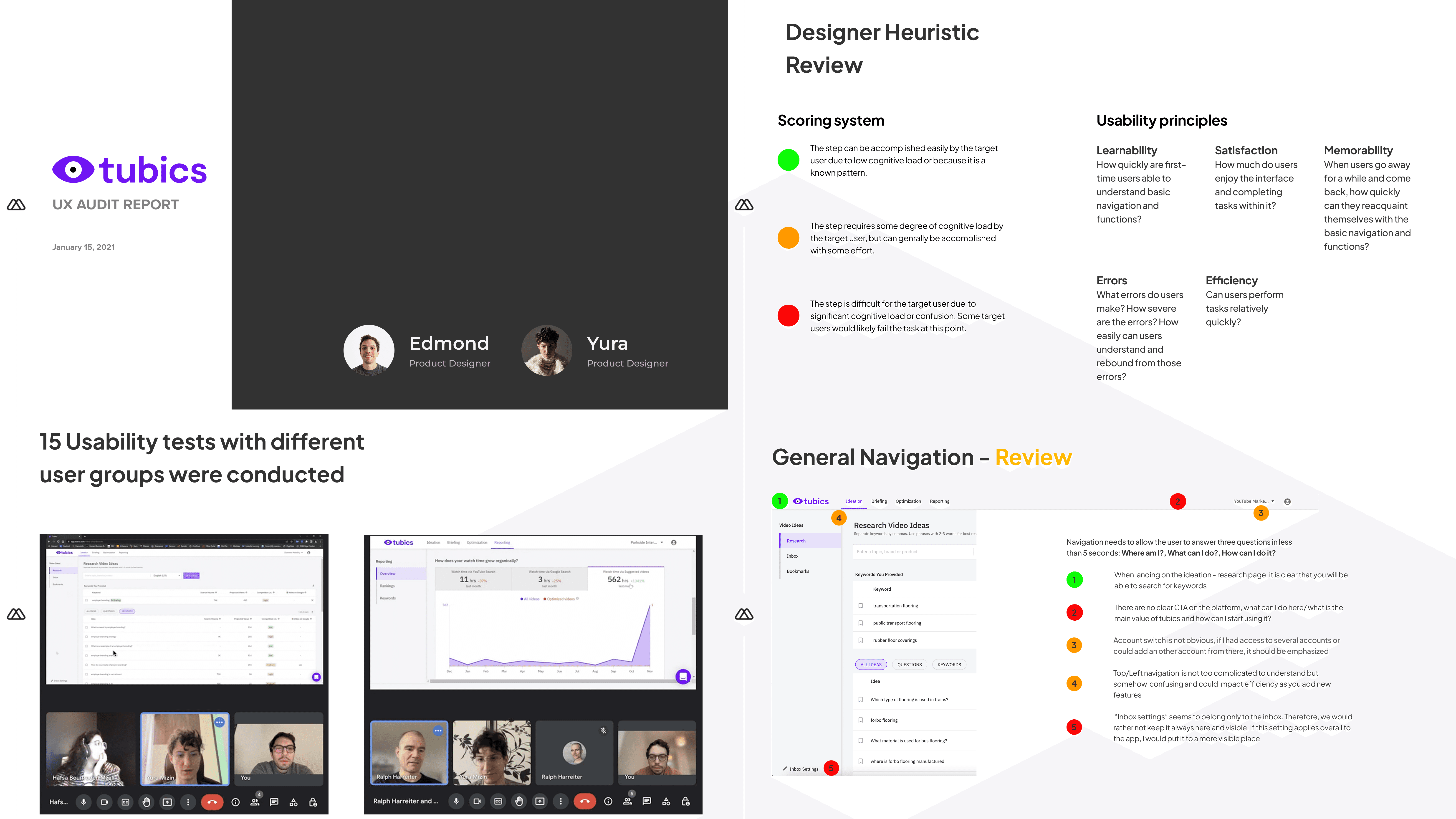
We ran usability research with 15 users — business owners and marketers who had either churned or were at risk of churning — to understand what was actually breaking down.
Three patterns emerged:
Data perception problems. Users didn't trust the numbers they were seeing. Metrics were presented without enough context to make them feel actionable. When data feels ambiguous, users stop checking it.
No habit-forming triggers. There was nothing pulling users back on a regular cadence. No clear reason to return tomorrow rather than next month. The product lacked the external and internal triggers that build routine use.
Interaction friction in core workflows. The IA made it hard to find what mattered. Users had to work to reach the actions that would give them value — and most didn't bother.
All findings were synthesized and maintained in a structured Dovetail repository, making it easy to align stakeholders on priorities and trace design decisions back to specific research evidence.

Design Approach
With the problems mapped, we had a clear framework for the redesign. We applied the Hooked Model — Trigger, Action, Variable Reward, Investment — as a lens for evaluating and restructuring core product moments.
Trigger: We redesigned the home experience to surface personalized recommendations and performance changes at a glance. Users needed a reason to open the app — and a reason to feel something had changed since their last visit.
Action: The IA was restructured to reduce the distance between arriving in the product and taking a meaningful step. Fewer clicks to insight. Clearer labeling. Prioritized workflows based on what research told us users actually came to do.
Variable Reward: Data insights were reframed with context — not just a number, but what it means, whether it's improving, and what to do next. This made checking the product feel more like discovering something than reading a report.
Investment: We looked at where users could input data, customize views, or build something that made the product more valuable over time — increasing the cost of leaving.
We prototyped in Figma and ran rapid validation cycles, iterating based on feedback before handing off.
Reflection
Stickiness problems are seductive to solve with features — a new dashboard, a new report, a new notification type. The research pushed us in the opposite direction: the problem wasn't missing features, it was missing clarity and missing cadence.
The most valuable output wasn't any single screen. It was the research repository. Tubics walked away with a structured, evidence-based picture of their users that could inform decisions long after the engagement ended. Good research compounds. A one-time redesign doesn't.